
OpenClaw first appeared in November 2025 — launched as Warelay, then renamed to Moltbot and, a few days later, OpenClaw — and within months it had gathered around 68,000 stars on GitHub and many forks. Against this hype, VELA looks modest: a small platform, no viral growth, no army of fans on Twitter. But it has something else.
This article isn't about who's better. It's an honest comparison of two different products for different people. One is an open-source AI agent for those ready to deploy a server and read documentation. The other is a ready-made AI assistant in Telegram in five minutes, no code.
What OpenClaw is and who it's for
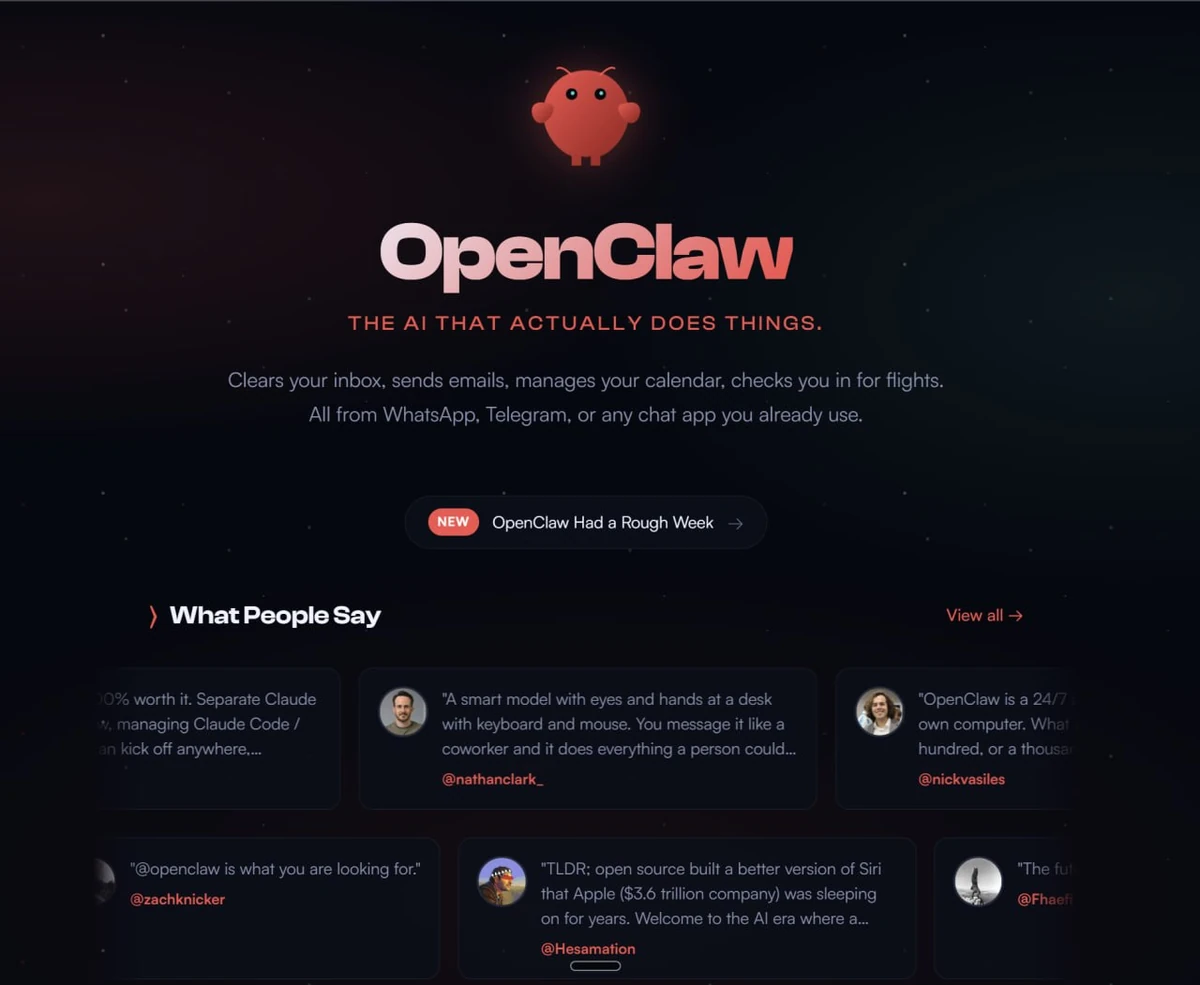
OpenClaw positions itself as "AI that actually does something" — cleans up your email, sends letters, manages your calendar, checks you in for flights. It works through WhatsApp, Telegram, Discord, Slack and 17 more messengers.
Under the hood — an open-source AI agent with more than 100 preinstalled AgentSkills. The user can add their own skills, host it on their own hardware, connect any LLM. That's exactly what explains the excitement on X — techies got a hackable tool that literally rebuilds itself mid-conversation.
But there's a nuance. OpenClaw requires installation, environment setup, a CLI interface. One fan on X wrote: "It's 2 a.m., and I'm still configuring." This isn't a bug — it's a feature for a particular audience. A developer wants control over every layer. An ordinary person just wants it to work.
What VELA is and who it's for
VELA is a platform for creating a personal AI assistant based on your own Telegram bot. You sign up, create a bot through @BotFather, paste the token — and in five minutes you have an AI assistant running on Claude from Anthropic. No server, no code, no CLI.
The target audience is different: specialists, entrepreneurs, active people who want to automate routine — in the messenger that's already open all day for them, and that's Telegram.
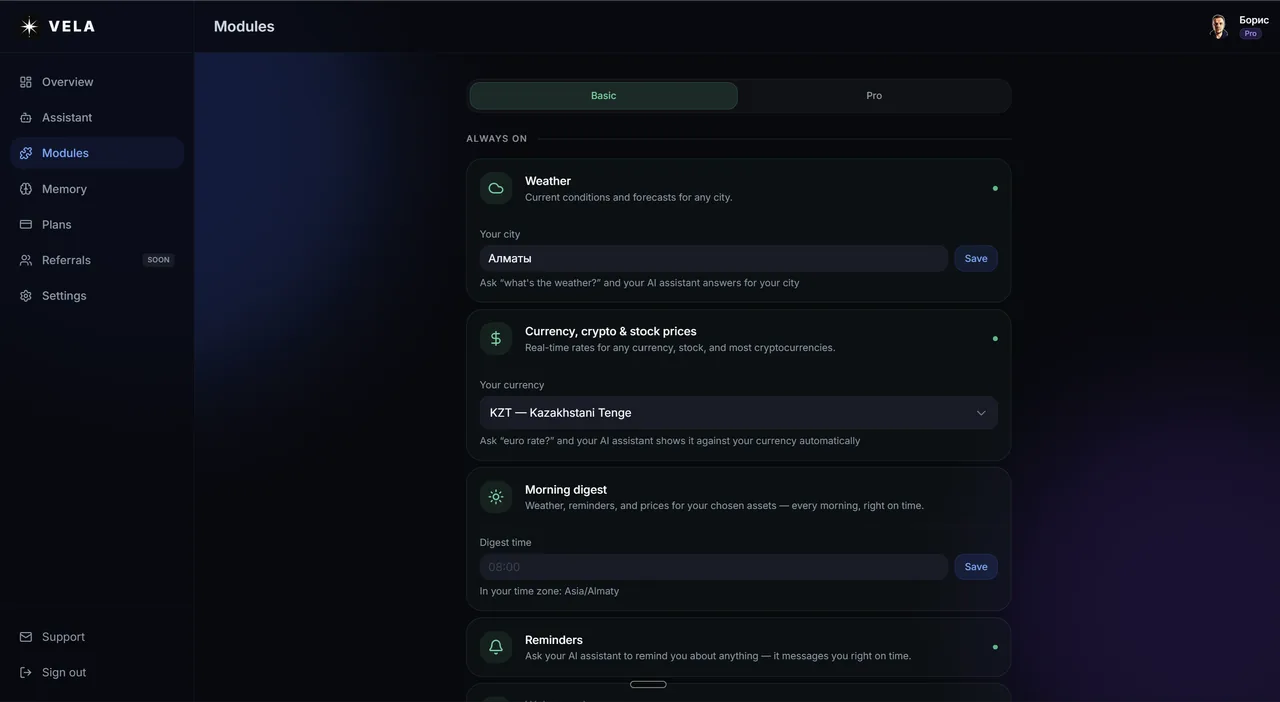
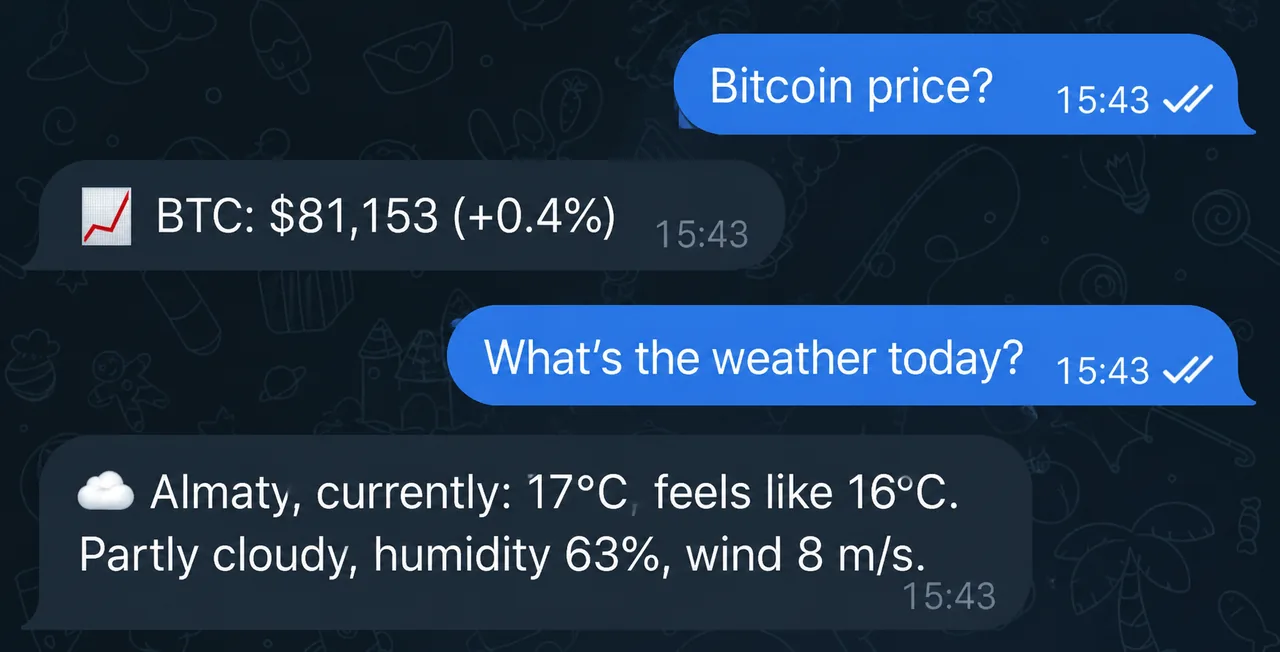
What VELA's AI assistant can do out of the box on the Basic plan for free: weather, currency and crypto rates, stocks, indices and precious metals, reminders, internet search, photo and document analysis, the morning digest, the guide (finding places and venues), long-term memory. Pro unlocks flight search, price alerts, advanced cryptocurrency search, all of Google Workspace — Calendar, Gmail, Tasks, Drive — plus image generation and reading Telegram channels through your personal account.
An important detail: the bot you create belongs only to you. It's your Telegram bot with the name and avatar you chose, not a shared service that thousands of other people use.
Where the real difference is
In short: OpenClaw is a tool for those who want to build. VELA is for those who want to use.
OpenClaw gives unlimited flexibility. You can connect any LLM — Claude Opus, GPT-5, Gemini, MiniMax and others. You can host locally on a Raspberry Pi or Mac Studio, or on a VPS (paid). You can write your own AgentSkill in an hour with the help of the agent itself. It's a real constructor with no ceiling.
VELA gives a ready-made solution. No server. No CLI. No environment setup. Claude works on all plans including the free one. Financial modules out of the box — rates, cryptocurrencies, flights, price alerts — OpenClaw doesn't have this ready-made, the user has to write the corresponding skill themselves.
One honest downside of VELA: there's no way to add your own integrations or write custom skills. The set of modules is fixed and there aren't that many of them compared to OpenClaw's capabilities. If you need integration with dozens or hundreds of different apps, auto-posting to social networks or something specific to your business — VELA's AI assistant won't cover it. For custom business scenarios (a consultant bot with a CRM, booking appointments, customer support, etc.) — you can order a custom build from Vibecraft.
What OpenClaw has that VELA doesn't
The honest part of the comparison.
Support for 20+ messengers: WhatsApp, Discord, Signal, iMessage and others. VELA's AI assistant works only in Telegram.
The ability to host locally — your data on your computer, not on someone else's server.
Full customization: any LLM, any skills, open source code.
Autonomous background work: the agent can run scheduled tasks, execute shell commands, work with the file system.
Summarization of Telegram group chats.
Around 68,000 stars on GitHub and a community of developers who actively write skills.
If you're a developer who needs a maximally flexible agent — OpenClaw is the obvious choice. This isn't a weakness of VELA, these are different classes of products.
Money and the entry barrier
OpenClaw is open-source, the main version is free. The paid cloud version, OpenClaw Cloud, costs $59/mo (first month $29.50). Plus separate payment for LLM requests based on actual usage. Or you pay for your own hosting yourself if you want to keep the AI agent running 24/7 on your VPS.
VELA: The Basic plan is free and forever. Pro — $9/mo (or $7/mo with annual billing). Payment by card or Telegram Stars (690 Stars ≈ $9). Everything is included — hosting the AI assistant, Claude under the hood, all modules according to the chosen plan.
For a non-technical user, OpenClaw's cost ends up higher: time on setup, paying for hosting, going through documentation. For a developer — the opposite, OpenClaw gives more for the same money.
We wrote in more detail about choosing an AI assistant by criteria in the article "How to choose an AI assistant: what to look at in 2026" — there we break down not only these two products, but also the general questions worth asking yourself before subscribing to any of the existing services.
FAQ
Are OpenClaw and VELA direct competitors? Essentially no. OpenClaw is a tool for techies who want to build and customize. VELA's AI assistant is a ready-made solution for people who want to use it without setup. There's some audience overlap, but it's small.
OpenClaw is free — so why pay for VELA? OpenClaw is free as code, but not as a service. You need a server or computer running 24/7, time for setup, and knowledge of the CLI. VELA handles all that for you — you pay for a finished, working product, not for the source code.
Can I use the VELA platform if I'm not a techie? Yes, that's exactly what it was created for. Registration and setup takes about five minutes: sign in on the site, create a bot through @BotFather in Telegram, paste the token into VELA. No code needed. No server needed. No card needed either.
Can I add my own integrations to VELA's AI assistant? No. The set of modules is fixed — the ones described on the site. Custom integrations, skills or connecting third-party services aren't supported. This is a fundamental difference from OpenClaw.
Which language model is in VELA? Claude from Anthropic — on all plans including the free Basic. On the Basic plan Claude Haiku works, on the Pro plan — Claude Sonnet for complex tasks and Haiku for fast answers. In OpenClaw you can choose any LLM: Claude, GPT, Gemini, MiniMax, local models and so on.